
This story did not begin with a sales meeting.
It began with a technical question.
A recycling investment group in Western Europe was planning a new PE film recycling line. The team had the site, the feedstock contracts, and the capital. What they still needed was a production concept that could work under Europe's cost structure — high industrial electricity prices, high labor costs, strict quality expectations, and limited tolerance for unstable operation.
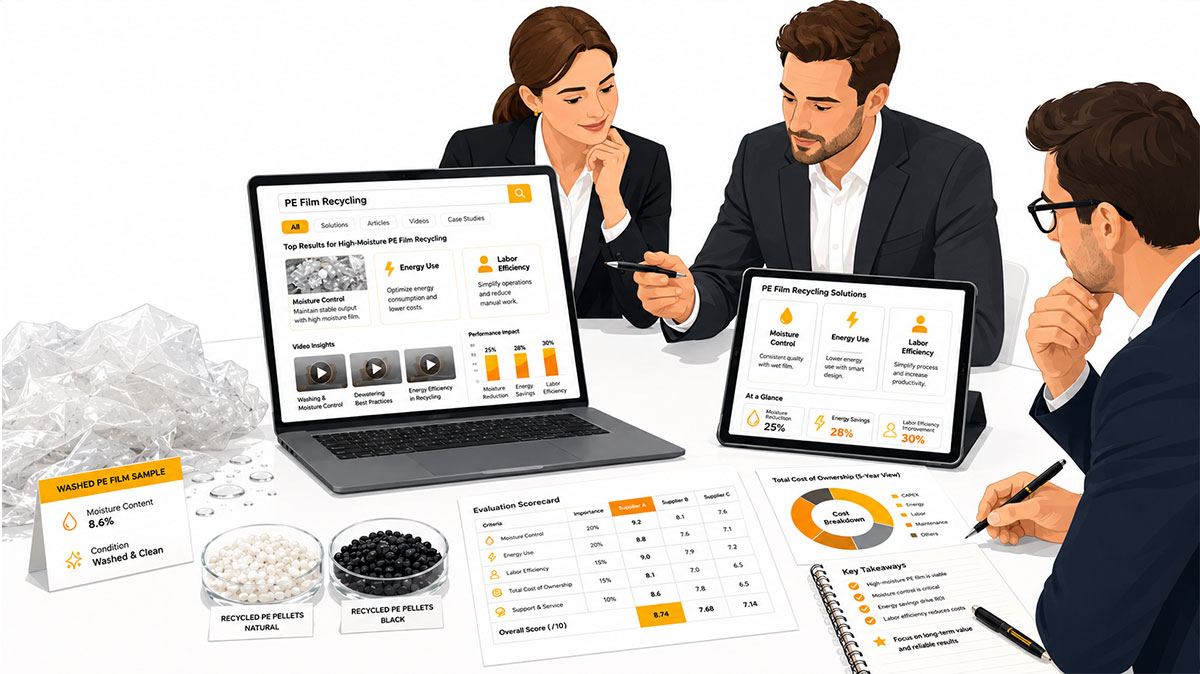
Before contacting any supplier, the team started where most modern industrial buyers now begin: online research.
They reviewed technical articles, product pages, equipment videos, and online discussions about high-moisture film recycling. They compared different ways to remove moisture after washing, reduce energy consumption, simplify the production flow, and produce stable recycled pellets.
During that research process, they came across GENIUS and the DWX Series Squeeze Dryer Integrated Recycling Machine.
What caught their attention was not only the machine itself, but the technical information behind it.
GENIUS provided detailed explanations of the key challenges in washed film recycling: why moisture control matters before extrusion, why multiple-machine systems increase energy and labor costs, and how an integrated squeeze-drying and pelletizing process can simplify the entire workflow.
Through the website, product information, and equipment videos, the team was able to understand the DWX concept before the first meeting even happened.
By the time they contacted GENIUS, they were not simply asking, "What machine do you sell?"
They were asking a more specific question:
Could this integrated system help make their European film recycling project more efficient, more stable, and more investable?
On paper, the business case for recycling PE film in Europe looks attractive. Recycled-content targets keep pushing demand for quality recycled pellets.
But between the targets and the profit sits a brutal spreadsheet — and three numbers kept turning it red.
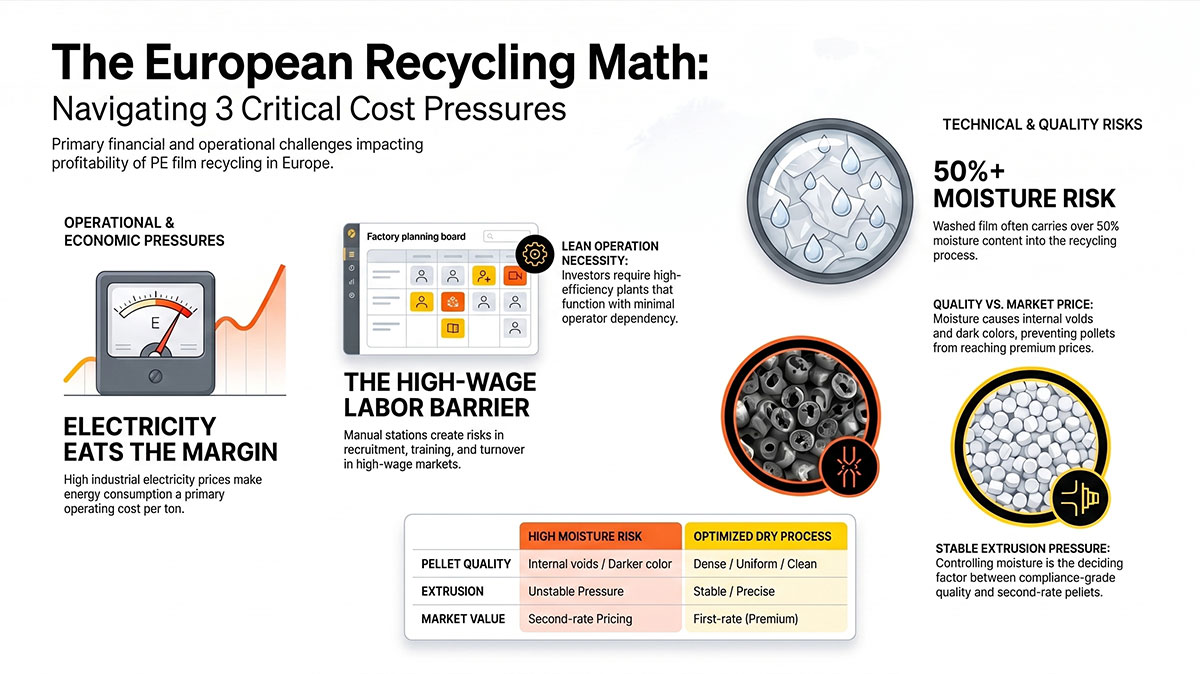
A conventional film recycling line runs several machines — and several main motors — around the clock.
At European industrial electricity prices, every installed kilowatt shows up directly in the cost per ton of pellets. The team's model showed energy as one of the largest single operating costs of the whole project.
In high-wage labor markets, every manual station on a multi-stage line — dewatering, bagging, transferring, re-feeding — is not just a salary.
It is recruiting, training, shift coverage, and turnover risk.
The investors wanted a plant that could run lean from day one.
Washed film materials can carry over 50% moisture content from the washing line.
If that moisture reaches the extruder, the result is familiar across the industry: unstable extrusion pressure, pellets with internal voids and a darker color — and in a market where buyers expect compliance-grade quality, second-rate pellets simply do not sell at first-rate prices.
What the search result described was not an incremental improvement.
It was a different architecture.
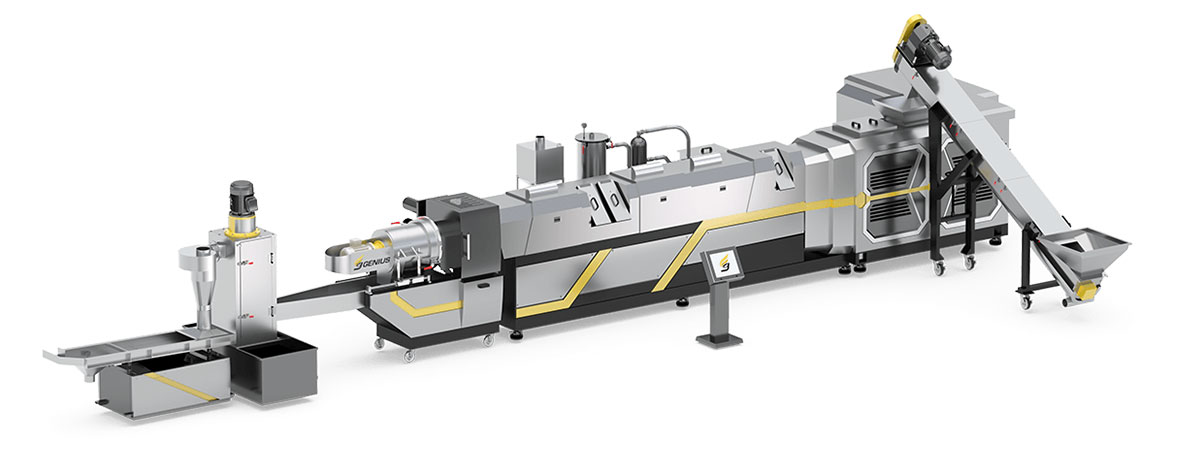
The DWX Series Squeeze Dryer Integrated Recycling Machine integrates two essential processes into one single machine, simplifying the workflow while saving valuable space, labor, and energy.
At the center of this design is a simple but powerful idea: dual function within one screw, powered by a single motor.
The squeezing stage reduces moisture from over 50% to 1–3% before the material enters the extrusion section. After extrusion and pelletizing, the final pellets come out completely dry.
For a European cost model, every part of that sentence lands somewhere on the spreadsheet:
The first email they sent asked for exactly one thing: the numbers behind the claims.
So we walked them through the same arithmetic we show every customer — and let their own engineers verify each step.
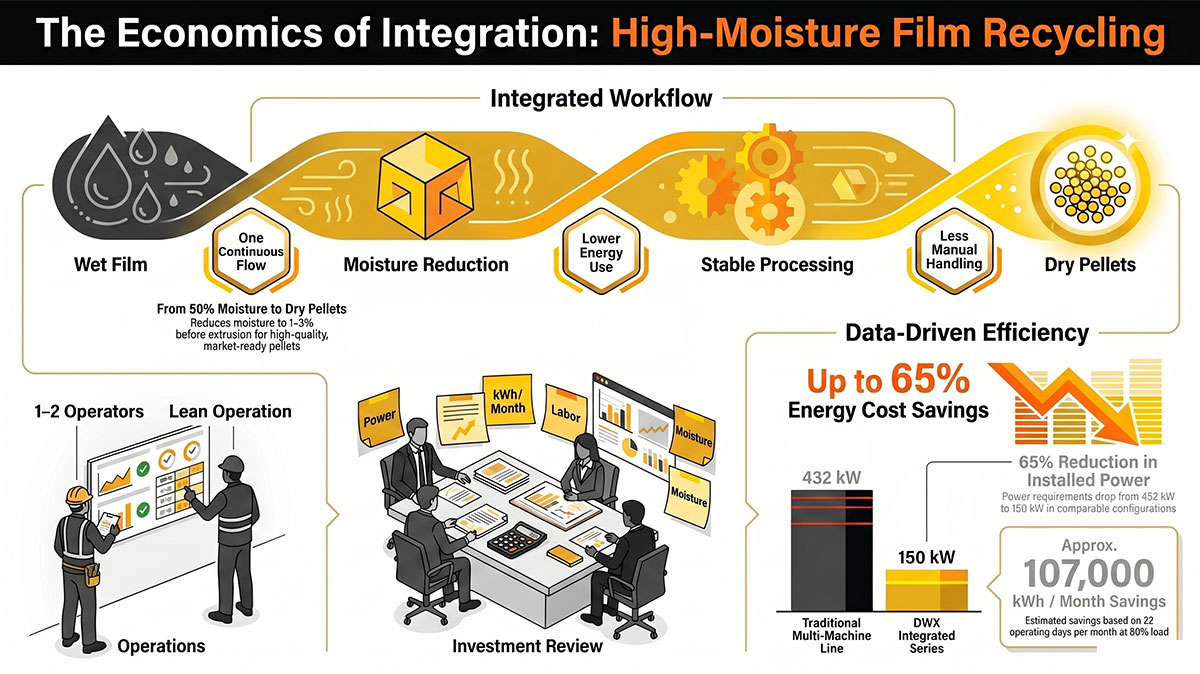
The DWX Series can deliver energy cost savings of up to 65%.
The reason is structural: a traditional line runs about three main motors across separate machines, while the DWX completes squeezing and extrusion with one screw driven by one motor.
In one comparison, installed main-motor power dropped from roughly 432 kW across three machines to a single 150 kW motor in a DWX-3512 class configuration.
Based on 24 hours per day, 22 operating days per month, and 80% load, this represents an estimated saving of approximately 107,000 kWh per month.
At European industrial electricity prices, the team converted that into a yearly figure that reshaped their payback model.
The exact value depends on the local electricity tariff, and actual consumption varies with material type, moisture content, and throughput.
Labor cost is also reduced because only 1–2 operators are needed to operate the whole plant.
In a high-wage labor market, every operator a line does not need is a number an investor reads twice.
The process takes material from over 50% moisture after washing down to 1–3% before extrusion, then produces completely dry pellets after extrusion and pelletizing.
For the investor group, this was not just a technical detail.
It was the basis for producing dense, consistent pellets that could target compliance-grade quality and full market price.
No exaggerated promises. No rounded-up brochure language.
Just a power comparison their engineers could check against motor ratings, and an estimate whose assumptions were printed right next to the result.
In their own words: "This is the first supplier whose numbers we could recalculate ourselves."
A few video calls, one round of engineering questions, and one verified spreadsheet later, the group signed.
For them, the DWX was not only a machine purchase.
It was the cost structure that made their European recycling project investable:
This project shows why equipment design matters so much in high-cost recycling markets.
For recyclers handling washed PE or PP film, the challenge is not only how to turn film into pellets. The real challenge is how to do it with lower energy consumption, fewer operators, stable moisture control, and a production layout that makes long-term financial sense.
In markets with high industrial electricity prices, installed power becomes one of the most important factors in equipment evaluation.
By combining squeezing, extrusion, and pelletizing into one integrated process, the DWX Series helps reduce unnecessary power consumption from separate machines and repeated material handling.
Traditional film recycling lines often require multiple machines, transfer points, and manual handling steps.
The DWX integrated design simplifies the process flow, helping recyclers reduce manpower requirements and operate the plant with only 1–2 operators.
For investors and plant owners, this means lower labor dependency and a more manageable operation from day one.
High moisture content is one of the biggest challenges in washed film recycling.
The DWX squeezing system reduces moisture from over 50% to 1–3% before extrusion, helping create a more stable pelletizing process and completely dry final pellets.
For recycling businesses targeting higher-value applications, this moisture control is essential for producing consistent, marketable recycled pellets.
For this European project, the DWX Series was selected because it addressed the buyer's most important concerns at the same time: energy cost, labor cost, moisture control, and overall investment efficiency.
For recycling companies planning a new PE or PP film recycling line, especially in high-cost markets, the DWX Squeeze Dryer Integrated Recycling Machine provides a compact and efficient solution designed for real production conditions.


