
Plastic scrap is one of the most accessible entry points into commodity recycling. Raw material is widely available, buyer demand for quality-grade recycled pellets continues to grow, and the processing technology is proven. The operators who build profitable businesses here share three things: they lock in their feedstock source before committing to any equipment, they configure their line for a specific material type — film or rigid, not both — and they solve the moisture problem before it reaches the extruder. Skip any one of those three, and the first 12–18 months become a costly correction exercise rather than a productive operation.
This article covers the pre-investment assessment that determines whether a plastic scrap business succeeds or stalls — starting with the question most buyers ask too late.
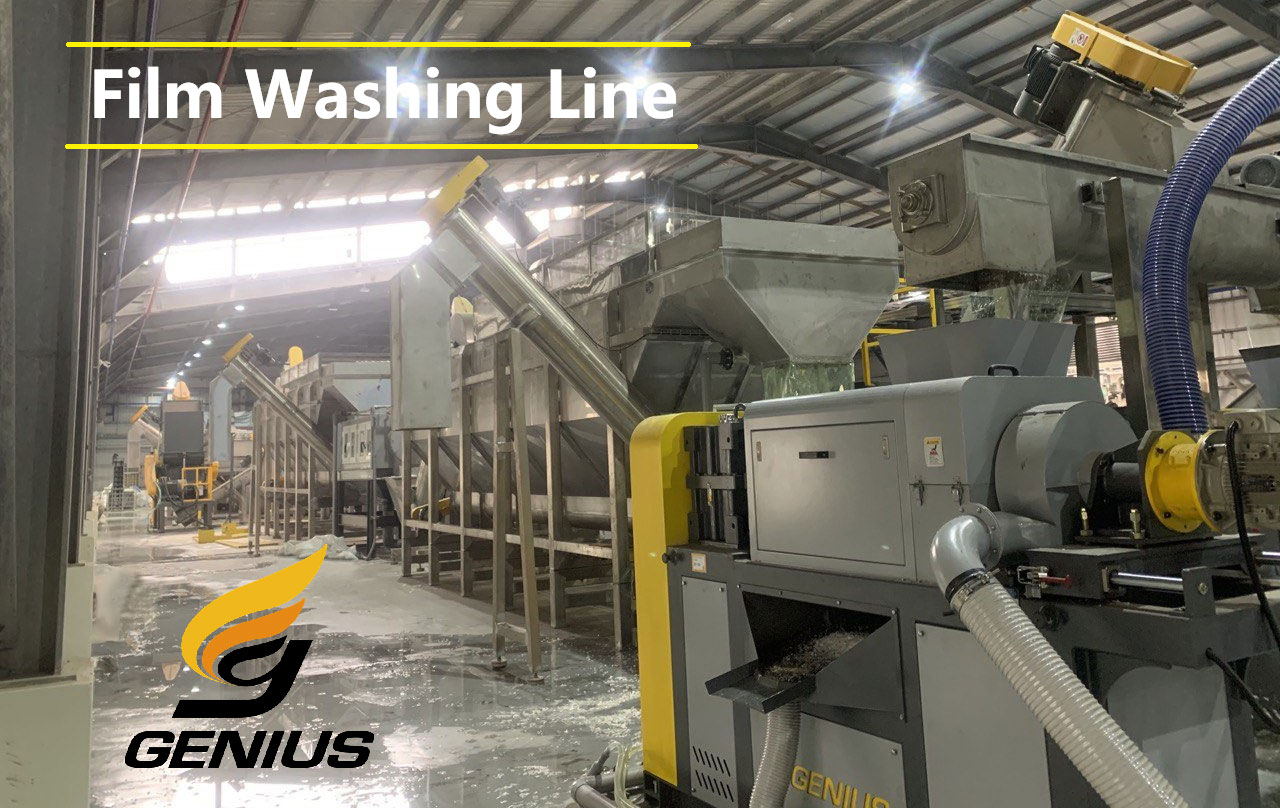
The right question is not "what equipment do I need?" — it is "what material am I actually processing?" The feedstock defines the line. Four variables determine which configuration will work and which will not:Operators who skip this step do not find the gap during equipment research. They find it three months into production, when pellets are being rejected for inconsistent melt flow index (MFI) or visible contamination. Retrofitting at that stage costs significantly more than configuring correctly at the start.
Of all four variables, material type has the biggest structural impact on line design — because film and rigid plastic do not just require different settings, they require different equipment categories entirely.
| Four feedstock variables that define your line configuration: |
|---|
|
A single line cannot handle all plastic scrap. Soft film and rigid plastic have different physical properties that require different equipment, different feeding approaches, and different drying methods. Configuring one line to handle both means compromising on both.
Agricultural films, stretch wrap, and post-consumer packaging bags share a set of processing demands that catch new operators off guard:
Rigid scrap — injection-molded parts, blow-molded containers, automotive components — is denser and less prone to bridging, but creates its own requirements:
If the feedstock is a mix of film and rigid, that means two separate line configurations — or a deliberate choice to specialize in one material category first. For a closer look at how rigid plastic recycling lines are configured end to end, see 3-Min Guide to Industrial Rigid Plastic Recycling.
Choosing the right material category is only part of the configuration decision. Within film recycling specifically, moisture content after washing is the variable that most directly determines whether the finished pellet meets commercial specifications — and it is the one most often underweighted at the equipment selection stage.
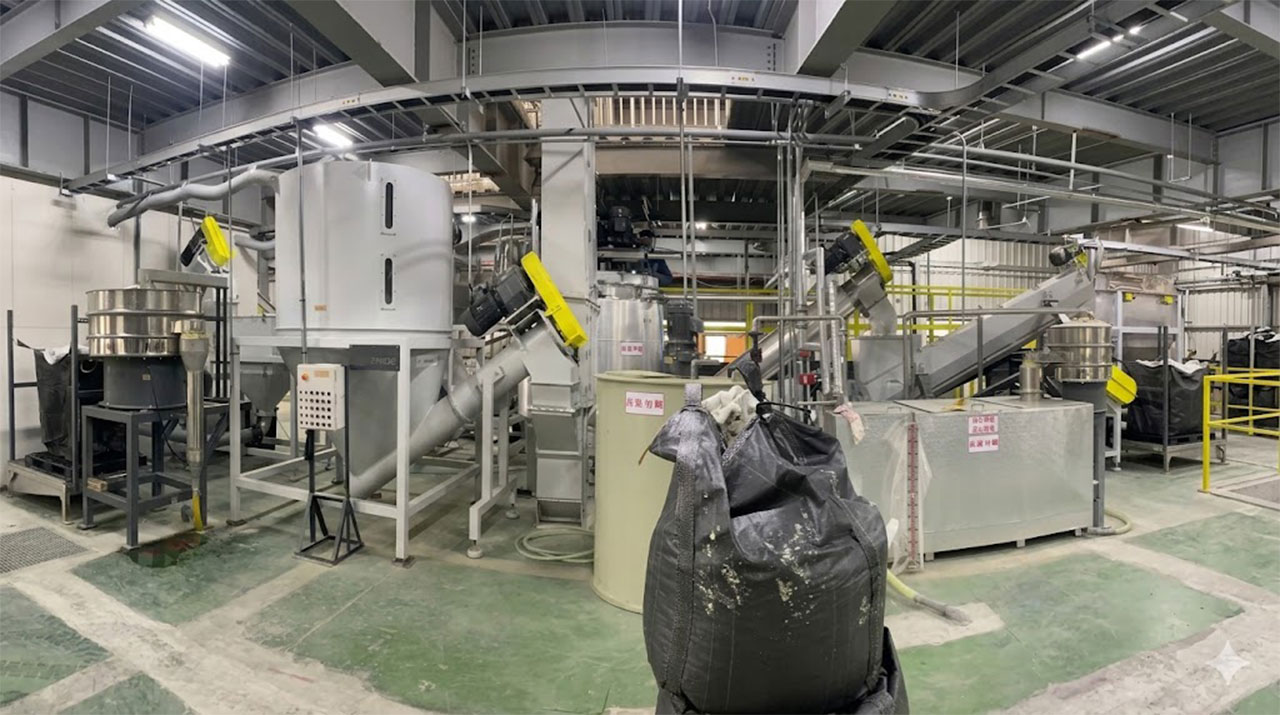
In film recycling, dewatering is the step that separates operators who consistently pass buyer quality checks from those who do not. High moisture content entering the extruder triggers a sequence of problems:
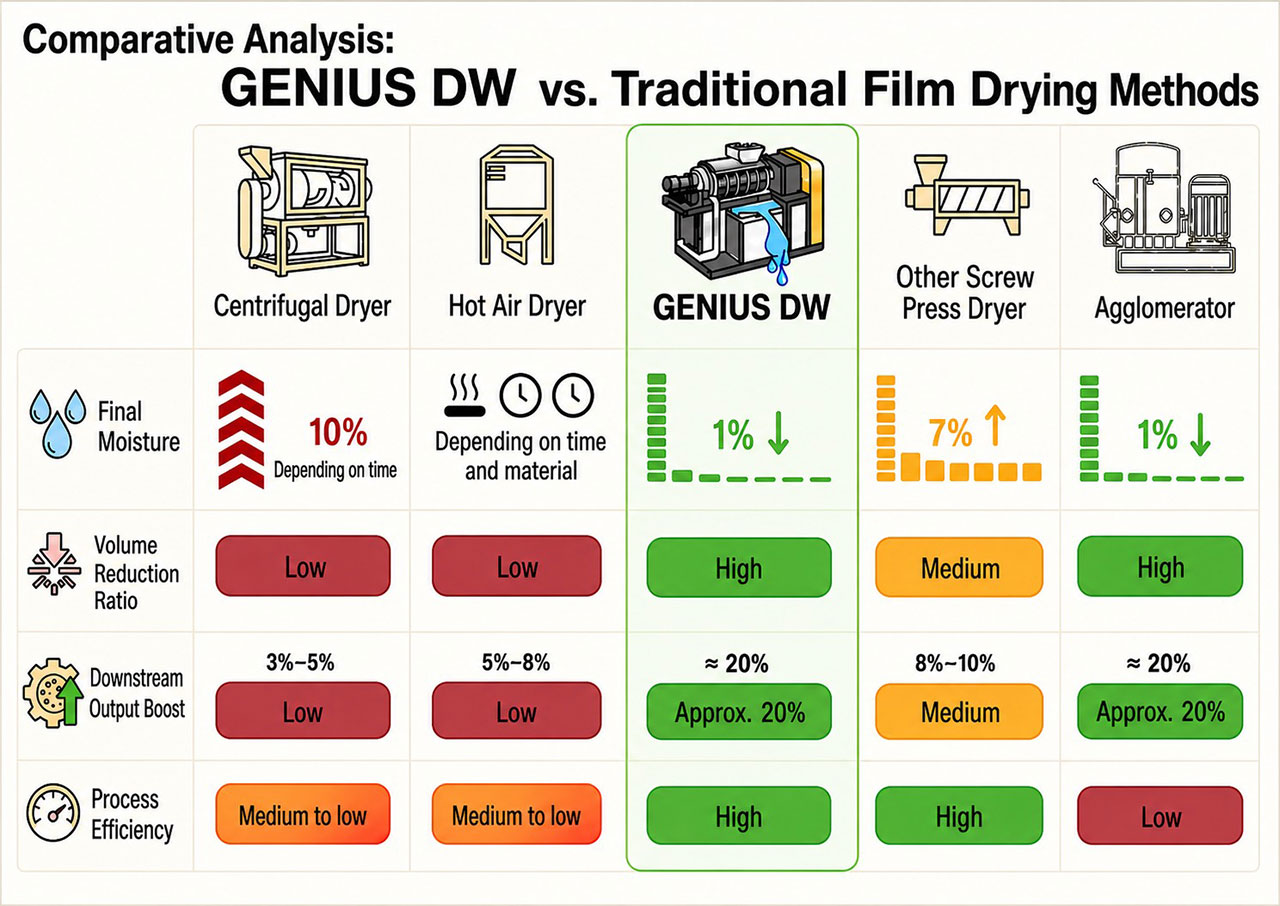
The industry benchmark for film recycling is moisture content below 1% entering the extruder. Most conventional dewatering equipment cannot reach that target on its own. A centrifugal dryer typically leaves 10%+ residual moisture. Even competing screw press dryers commonly output material at 7–10% — still too wet for direct extrusion. This is why many lines add a hot air dryer as a second stage: to compensate for what the dewatering equipment cannot do alone. The GENIUS DW squeeze dryer is designed to eliminate that workaround entirely. By applying controlled mechanical compression, it brings moisture down to 1–3% or below — replacing both the centrifugal dryer and the hot air dryer on the wash line, with no thermal drying stage required. The result is stable melt quality, longer filter screen life, and pellets that meet buyer specifications consistently.
| Case study : PP marine net recycling — Europe |
|---|
|
A European recycler processing post-consumer PP marine nets was experiencing severe throughput limitations after the wash stage. The nets — bulky and moisture-laden after washing — could not feed into the pelletizing line at rated capacity. Output was erratic, and the material bridged frequently at the extruder inlet. After integrating a squeeze dryer, the operator reported a 50% increase in pelletizing throughput. Mechanical compression reduced both moisture content and bulk volume simultaneously, resolving the bridging problem and bringing the line to its design capacity. It is worth noting that PP marine nets — with their loose, fibrous, cotton-like structure — are in many respects more challenging to process than standard plastic film: they absorb more moisture, resist even flow, and tangle more aggressively. The same squeeze-dry principle that resolves film bridging applies with equal or greater effect to bulky fiber-like materials. For a visual demonstration of this process, see: Plastic Squeeze Dryer for PP Marine Net Recycling | Moisture Below 1% - Genius Machinery
|
That 50% throughput gain came from solving the moisture and density problem upstream — not from upgrading the extruder or pelletizer. For a detailed breakdown of how moisture levels affect PCR pellet acceptance, see Post-Consumer Plastic Recycling: Why Dewatering Determines Whether Your PCR Output Gets Accepted or Rejected.
Solving the moisture problem correctly is the single most important technical decision on a film recycling line. It is also the decision most often driven by purchase price rather than operating cost — which is where equipment comparisons tend to mislead.
Further reading: How Screw Press Dewatering Machines Revolutionize Plastic Film Recycling
Capital expenditure (CapEx) comparisons are a standard starting point, but two lines with a $60,000 price difference at purchase can look very different over 24 months of operation. Four variables that a purchase price comparison does not capture:
The answers to these five questions define your line configuration more precisely than any catalog comparison — and give you the inputs you need to hold suppliers accountable to operating cost, not just purchase price.
Define it precisely: resin types, contamination sources, percentage of non-recyclable material, and bale density. If buying from brokers, arrange sample bale trials at a processing facility before committing to equipment. If collecting from industrial generators, get their quality data in writing.
Know your buyer's requirements before designing the line. Pellet color tolerance, MFI range, maximum contamination level, and pellet size determine filter configuration, pelletizer type, and degassing requirements. Melt filter selection in particular is driven directly by your contamination level and output quality target — see 6 Factors to Consider When Choosing Melt Filters for Plastic Recycling Extrusion Machines for a full breakdown. A line built for commodity-grade output cannot be economically upgraded to food-contact PCR (post-consumer recycled) grade.
If the answer is both, start with one. A single line can be configured for a mix, but the compromises are real. Most operators who scaled successfully in plastic scrap recycling proved the economics on one material category first, then added capacity for the second. If film is your starting point, 5 Steps to Building Your Own Plastic Film Recycling Washing Line covers the full plant configuration process from feedstock assessment through commissioning.
Reject handling affects which equipment you need before the line starts running, not just how you operate it afterward. Washing lines produce wet rejects — typically 5–15% of input volume for post-consumer film. In markets where incineration is subject to fees (including the EU, where waste incineration now falls under the EU Emissions Trading System, EU ETS), wet reject sludge is a growing operating expense. Applying a squeeze dryer to the reject stream — not just the clean film stream — reduces both volume and weight before disposal, and the extracted water can be filtered and returned to the wash circuit. This equipment decision needs to be made before the line is designed, not after it is installed.
Further reading: Stop Paying to Transport Water: Squeeze Dryer Strategy for Cutting Disposal Costs & Carbon Footprint
Line scale should follow confirmed supply, not projected growth. A 500–2,000 tonne/year entry line makes sense when supply contracts cover that volume reliably. Oversizing ties up capital; undersizing leaves margin unrealized. Secure supply agreements covering at least 6–12 months of guaranteed volume before committing to equipment. For a breakdown of what each scale tier requires in terms of equipment and investment, see Choosing the Right Plastic Recycling Plant: Small, Medium & Large-Scale Options.
Those five questions are the materials assessment. Operators who answer them before the first supplier meeting walk into that meeting with a defined configuration — and the data to evaluate whether what they are being quoted actually fits their operation.
Further reading: Plastic Recycling Process: Step-by-Step Guide
The plastic scrap businesses that run profitably share a consistent pattern: material assessment comes before equipment selection. Before the first supplier meeting, they know their moisture levels, contamination profile, and buyer's specification sheet. They run a 24-month operating cost model, not just a purchase price comparison.
A correctly configured line — feeding system matched to material density, dewatering matched to moisture profile, filtration matched to contamination level — produces consistent output at predictable cost. An incorrectly configured line does not, regardless of nameplate specifications.
The materials assessment described here is not technically complex. It requires asking the right questions before the equipment conversation starts — and using the answers to drive every configuration decision that follows.
Plastic scrap becomes a profitable raw material when the processing line is matched to the feedstock — not the other way around. Genius Machinery provides material-specific line engineering, from initial feedstock assessment through equipment selection and commissioning, backed by in-region support across Europe, Japan, and Mexico. Contact our engineering team with your material type, contamination profile, and target output specifications to start the conversation.


