LDPE — Low-Density Polyethylene, resin identification code #4 — is a thermoplastic produced by high-pressure polymerisation of ethylene. Its highly branched molecular structure gives it flexibility, transparency, and low density — ideal for flexible packaging applications.
Before diving into how LDPE is recycled, it helps to know which forms of it actually make it into the recycling stream:
LDPE film is recycled under a separate process from other plastics because of one physical property that sets it apart from the bottles and containers most people picture when they think of plastic recycling: its extremely low bulk density. In baled form, LDPE film can reach as low as 20–30 kg/m³ — roughly the density of a cloud relative to water. This creates bridging problems in feeding equipment, inefficiency in drying, and tangle-related damage in sorting machinery that simply do not exist for rigid polymers like PET or HDPE bottles.
| Why LDPE #4 is not accepted in curbside recycling bins |
|---|
|
Unlike #1 (PET) and #2 (HDPE), which are widely collected curbside, LDPE film #4 is rejected by most kerbside programmes because loose film tangles in sorting conveyor belts and causes costly equipment jams at materials recovery facilities (MRFs). LDPE film is instead collected through store drop-off programmes (clean, dry film deposited at retail locations) or directly from industrial generators. The quality and consistency of input at collection is the single biggest determinant of what is achievable in the recycling process downstream. |
A complete mechanical recycling line for LDPE converts incoming baled waste into rLDPE pellets through six sequential stages. The table below gives an overview of the full flow; each stage is then explained in depth.
| # | Stage | What happens | Why it matters |
|---|---|---|---|
| 1 | Sorting & size reduction | Bales broken; NIR sorting; wet granulation to 20–40 mm flakes | Removes non-LDPE before wash water contamination |
| 2 | Hot-wash | 60–85 °C alkaline wash removes food residue, inks, adhesives | Determines pellet purity and odour — the highest-leverage stage |
| 3 | Rinse & float-sink | Counter-current rinse; LDPE floats, PET/PVC/glass sink | Removes heavier polymer contamination to <200 ppm |
| 4 | Squeeze drying | Mechanical compression reduces moisture >50% → <1% | Sub-1% moisture is mandatory for stable melt extrusion |
| 5 | Melt extrusion & degassing | Low-shear melting; vacuum degassing; continuous melt filtration | Determines pellet homogeneity, MI stability, and purity |
| 6 | Pelletizing & classification | Underwater or strand cutting; vibrating screen removes fines | Produces 3–4 mm rLDPE pellets to specification |
Film then enters a wet granulator, which simultaneously shreds it to 20–40 mm flakes while washing off loose surface contamination. Flake size matters: too large reduces washing efficiency; too small produces fines that are difficult to dewater and cause losses through rinse screens.
Film then enters a wet granulator, which simultaneously shreds it to 20–40 mm flakes while washing off loose surface contamination. Flake size matters: too large reduces washing efficiency; too small produces fines that are difficult to dewater and cause losses through rinse screens.
Hot-washing is the single most important stage in the LDPE recycling process. Granulated flakes pass through a friction washer or hot-wash tank at 60–85 °C with a controlled alkaline detergent solution (NaOH-based, pH 11–12). The combination of elevated temperature, alkaline chemistry, and mechanical friction work in concert to remove food residue and fats (via saponification), printing inks and dyes, pressure-sensitive adhesive residues, and organic odour compounds.
Residence time is 3–8 minutes depending on contamination level. Post-consumer grocery bag streams require longer residence and higher detergent concentration than clean post-industrial stretch wrap. The stakes here are high: incompletely removed contaminants do not disappear during extrusion — they carbonise into black specks and gels, which is the single most common reason for rLDPE pellet rejection by downstream film manufacturers.
After hot-washing, flakes carry residual alkaline detergent that must be fully removed before extrusion — residual alkalinity degrades pellet colour and causes processing instability. Two-stage counter-current rinse tanks dilute and eliminate detergent, with clean water entering at the last tank and flowing counter to the film, ensuring the freshest water always contacts the cleanest material.
The final rinse tank doubles as a float-sink separator: LDPE (density ~0.92 g/cm³) floats; PET (1.38), PVC (1.30), sand, and glass sink and are removed by a bottom screw conveyor. A properly operated float-sink system reduces non-LDPE polymer content to below 200 ppm — the standard specification threshold for film-grade rLDPE.
Flakes exiting the rinse tanks carry 30–60% moisture by weight — and that number must come down to below 1% before the material enters the extruder. Even 2–3% residual moisture causes violent steam generation at melt temperature (180–220 °C), producing bubble voids in the pellet and unstable melt flow index — the most common complaint from processors using rLDPE.
The challenge specific to LDPE film: conventional centrifugal dryers achieve only 15–25% moisture removal on LDPE film because the low-density, flexible flakes do not pack under centrifugal force. This is why moisture-related pellet defects are so prevalent in poorly specified LDPE recycling lines.
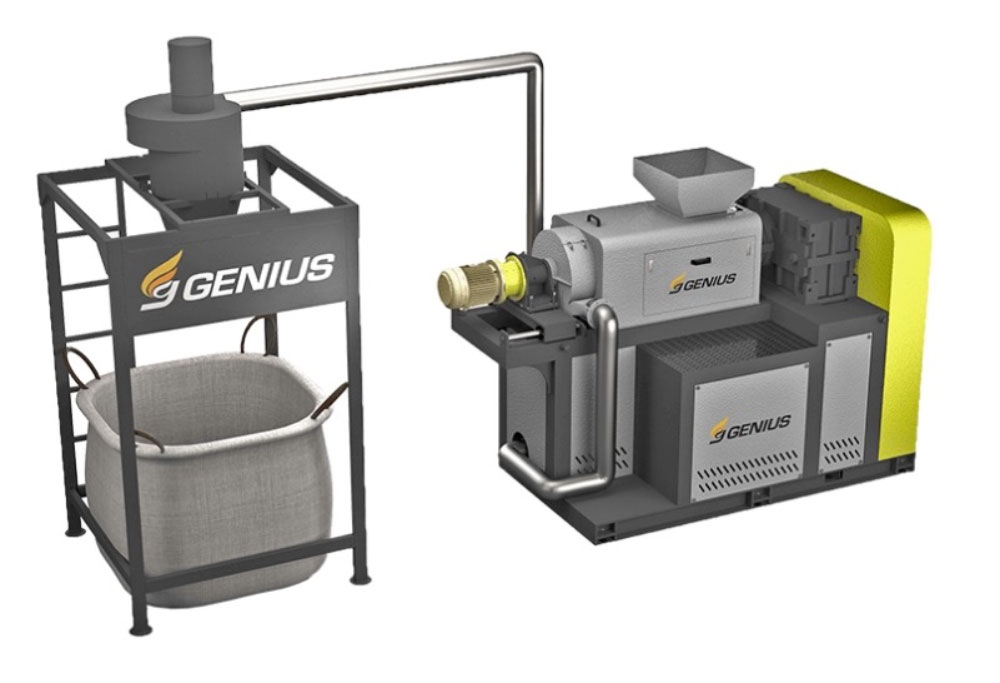
| Equipment spotlight: Genius DW Series Squeeze Dryer |
|---|
|
Engineered specifically for post-wash LDPE and LLDPE film, the DW Series uses a purpose-designed compression screw that physically wrings moisture from film flakes under high mechanical pressure — achieving consistent outlet moisture below 1%, regardless of inlet moisture variation. Key specifications:
Real-world result: A post-consumer film recycler in Japan integrated the DW Series. Outlet moisture dropped from 25–35% to <1%. Pellet rejection rate fell from 15–20% to under 3%. Overall throughput increased 30–50%. Full specifications and model selection: Plastic Squeeze Dryer
|
The principle applies beyond any specific equipment: any LDPE recycling line that does not achieve sub-1% moisture before extrusion is generating downstream quality problems that cannot be corrected at a later stage.
The LDPE film feeding problem: LDPE film's bulk density of 20–60 kg/m³ causes bridging in standard gravity-fed extruder hoppers — the lightweight flakes arch across the hopper opening and starve the screw, causing throughput fluctuations of ±30% or more. Specialised feeding systems pre-densify the film and force-feed it into the screw under controlled pressure, maintaining stable fill rates.
Once the feeding problem is solved, the next concern is what happens inside the extruder itself. Screw design for LDPE's heat sensitivity: LDPE degrades under excessive shear heat — each thermal cycle breaks polymer chain branches, reducing molecular weight and contributing to the melt flow index variability that processors experience with rLDPE. LDPE-specific extruder screws use deep flight channels (lower shear stress) and longer L/D ratios of 30:1 to 36:1, allowing melting through gentle conductive heat at lower screw speeds.
Degassing: even after squeeze-drying, some residual moisture and volatile organic compounds remain in the flakes and must be drawn out before pelletizing. A single-stage atmospheric vent handles post-industrial streams. For post-consumer film or food-contact applications, a two-stage vacuum degassing system (0.05–0.10 mbar) performs deep decontamination that can, depending on specific material and testing conditions, approach the migration limits required by FDA and EFSA food-contact regulations — exact compliance depends on the application and must be validated against local requirements.
Melt filtration: continuous screen changers (80–150 mesh) remove carbonised particles and metal traces. Automatic non-stop screen changers maintain constant melt pressure during screen changes — essential for variable post-consumer input streams.
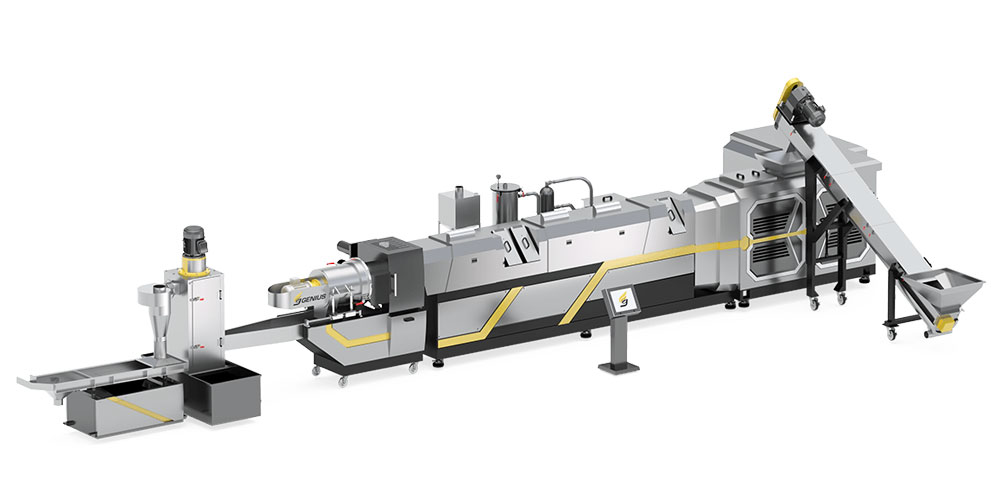
| Equipment spotlight: Genius DWX — Squeeze Dryer Integrated Recycling Machine |
|---|
|
For washing lines where squeeze drying and pelletizing are combined into a single step, the DWX Squeeze Dryer Integrated Recycling Machine eliminates the need for a separate pelletizing extruder — reducing footprint, energy consumption, and labour requirements. Key features:
Available models: DWX-3815 (700 kg/hr) · DWX-3512 (500 kg/hr) · DWX-3010 (300 kg/hr). All models customisable to customer requirements. See full specifications: Squeeze Dryer Integrated Recycling Machine
|
With clean, homogeneous melt flowing at stable pressure, the final stage is straightforward. Filtered melt exits the die and is cut by either a strand pelletizer (strands cooled in a water bath, cut to length) or an underwater pelletizer (cutting head submerged in cooling water, producing spherical pellets). Underwater pelletizers are preferred for high-throughput lines and applications requiring tight pellet geometry control.
Pellets are centrifugally dried and classified through a vibrating screen to remove fines and oversized pieces. Standard rLDPE pellet diameter is 3–4 mm. Classified pellets are sampled for melt flow index, density, colour, and contamination level before bagging.
The process described above is mechanical recycling — the polymer chain is preserved, and the output is a recycled pellet ready for reuse. Chemical recycling (primarily pyrolysis) takes a fundamentally different approach: it breaks LDPE down into hydrocarbon oil used as fuel or petrochemical feedstock. The two pathways are not competing alternatives; they are complementary routes that serve different fractions of the waste stream, as the comparison below shows.
| Criterion | Mechanical recycling | Chemical recycling (pyrolysis) |
|---|---|---|
| Best input stream | Clean to moderately contaminated mono-material LDPE/LLDPE film | Heavily contaminated or multi-layer film unsuitable for mechanical processing |
| Output product | rLDPE pellets — polymer retained | Pyrolysis oil / naphtha — polymer broken down |
| Can replace virgin LDPE? | Yes — for film, injection moulding, and packaging | No — output is fuel or chemical feedstock, not plastic |
| Energy input | ~0.3–0.6 kWh/kg | ~1.5–3.0 kWh/kg |
| CO₂ saving vs virgin | ~1.8 tonnes CO₂e per tonne rLDPE | ~0.8–1.2 tonnes CO₂e per tonne output |
| Contamination tolerance | Moderate — up to ~5% non-LDPE | High — processes mixed, contaminated streams |
| Commercial maturity | Mature — widely deployed at scale globally | Emerging — growing investment, limited commercial scale as of 2026 |
In practice, mechanical recycling handles 60–80% of a typical post-consumer LDPE film stream. The remaining 20–40% — heavily contaminated film, complex multi-layer structures, black carbon-pigmented film — is better directed to chemical recycling, where high contamination is simply a characteristic of the feedstock rather than a problem that limits pellet quality.
The industry is converging on what we describe as ‘quasi-chemical outcomes through physical means’ — achieving contamination removal that previously required chemical treatment, delivered at the throughput and cost economics of mechanical processing. Two technologies are leading this shift.
Current NIR sorters have two known limits: black films pigmented with carbon black are opaque to standard NIR sensors; and distinguishing LDPE from LLDPE or HDPE film grades — all polyolefins with similar NIR signatures — is unreliable at production speeds.
Next-generation systems combine hyperspectral NIR with AI models trained on tens of millions of material samples, identifying polymer type, colour, and contamination on individual flakes at belt speeds above 3 m/s — with claimed foreign-polymer rejection rates of 99.9%. Deployed at pre-sort, this eliminates the majority of cross-contamination before it reaches the washing line, reducing hot-wash chemical consumption and improving float-sink reliability.
While AI sorting addresses contamination at the front end of the line, the second technology tackles what remains after all the mechanical processing is complete. The most significant development on the horizon is supercritical fluid extraction (SFE) as a post-mechanical decontamination step. Supercritical CO₂ (above 31.1 °C and 73.8 bar) penetrates the LDPE polymer matrix and extracts mineral oils, ink compounds, adhesive residues, and odour-causing volatile molecules that hot-washing cannot reach.
The result is rLDPE that meets the migration limits required for direct food contact packaging and premium cosmetics packaging — markets currently closed to mechanically recycled LDPE. Commercial pilot installations in Europe are demonstrating consistent results as of 2026. This technology represents the pathway through which post-consumer LDPE film could access the highest-value rLDPE markets within the next three to five years.
|
Client: Specialist post-consumer LDPE film recycler, Japan Challenge: The plant's centrifugal-only drying stage was achieving 25–35% outlet moisture. Residual moisture caused bubble defects and black specks in pellets, producing a 15–20% pellet rejection rate at QC. The extruder had to run at reduced speed to manage melt instability. Intervention: Genius DW Series Squeeze Dryer integrated between counter-current rinse tanks and the extruder feed. Results: Outlet moisture 25–35% → below 1% (consistent) Pellet rejection rate 15–20% → below 3% MI batch variability ±25% → ±8% Overall throughput → +30–50% (extruder at full design speed) Payback period → approximately 14 months Key insight: moisture management at the drying stage is the highest-leverage single intervention available in an existing LDPE recycling line — and the stage most frequently under-specified in original plant designs. |
The case study above illustrates what good equipment and process design can achieve. But the LDPE recycling process actually begins long before film reaches a recycling facility — it begins at the design stage. Decisions made by film manufacturers and brand owners directly determine whether a product can be mechanically recycled into high-quality rLDPE, or will join the fraction that is downcycled or landfilled.
Good process design — from the film's original specification through to the recycling line itself — is what separates a high-performing rLDPE operation from one that struggles with quality and throughput. Genius Plastic has spent nearly three decades engineering the equipment that makes the difference. Since 1975, we have designed and manufactured LDPE film recycling lines with installations in 30+ countries across Asia, Europe, and the Americas.
| Product / System | What it solves in the LDPE recycling process |
|---|---|
| DW Series Squeeze Dryer |
Stage 4 moisture problem: reduces post-wash moisture from >50% to below 1% consistently. Multiple throughput models (500–3,000 kg/hr). →
|
| Cutter-Compactor System |
Stage 5 feeding problem: tangential forced feeding eliminates LDPE bridging; VFD dynamic balancing maintains ±5% melt pressure. Throughput increase: 50%+.
|
| Complete LDPE Washing Line |
Full-line solution: wet granulator → friction washer → float-sink → DWX squeeze dryer integrated recycling machine (squeeze drying + pelletizing in one unit). Configured for post-consumer or post-industrial.
|
To discuss a line configuration for your specific input stream, contact our engineering team.
The LDPE recycling process is a mechanical sequence that converts waste LDPE plastic — bags, films, and wrapping — into rLDPE pellets for reuse. The six stages are: sorting and size reduction, hot-wash decontamination at 60–85 °C, rinsing and float-sink polymer separation, squeeze drying to below 1% moisture, melt extrusion with vacuum degassing and filtration, and pelletizing and classification. The resulting pellets partially or fully replace virgin LDPE resin in blown film, injection moulding, and packaging applications.
Yes — LDPE (resin code #4) is mechanically recyclable. It is not accepted in most curbside recycling bins because loose film causes equipment jams in sorting facilities. LDPE film is instead collected through store drop-off programmes at major retailers, or directly from industrial generators. Once collected clean and dry, it can be mechanically recycled into high-quality rLDPE pellets with properties close to those of virgin LDPE.
Moisture content must be below 1% by weight before film flakes enter the extruder. Higher moisture causes steam generation at melt temperature (180–220 °C), producing bubble voids in pellets and melt flow index instability. Centrifugal drying alone achieves only 15–25% moisture reduction on LDPE film and is insufficient as the sole drying method. A mechanical squeeze dryer is required to consistently achieve sub-1% moisture.
The five main challenges are: (1) limited collection infrastructure — most LDPE film does not reach a recycling facility; (2) contamination — food residue, inks, and mixed polymers require intensive washing; (3) low bulk density — creates bridging in equipment and drying problems; (4) melt flow index instability in the recycled pellet from mixed input streams; and (5) reduced tensile strength in recycled film versus virgin. All are addressable through proper process design.
Recycled LDPE (rLDPE) is used in: new plastic bags and film (typically blended with virgin at 20–50% recycled content); agricultural and construction film; geomembrane; plastic lumber and composite decking; bin liners and industrial sheeting. With advanced two-stage vacuum degassing, rLDPE from post-consumer streams is being developed for food-contact packaging applications.
LDPE and HDPE recycling use similar washing chemistry but differ significantly in feeding and drying. LDPE film's very low bulk density (20–60 kg/m³) requires specialised compactor-based feeding systems — standard gravity-fed hoppers cause bridging. HDPE regrind feeds reliably by gravity. LDPE film also absorbs more surface water per unit weight, requiring more aggressive mechanical drying. Extrusion temperatures are broadly similar, though LDPE requires more careful screw design to prevent shear-induced thermal degradation.
Having walked through the full process, the common challenges, the technology horizon, and a real-world result, a few principles stand out consistently. LDPE recycling is technically viable and commercially operational worldwide — the process works. But output quality is highly sensitive to the decisions made at every stage, and the difference between a struggling line and a high-performing one usually comes down to these five factors:
The operations that invest in correctly specified equipment — particularly at the drying, feeding, and decontamination stages — are best positioned to supply the premium rLDPE markets opening up as EPR regulation and brand commitments create new demand for high-quality recycled content. For a complete guide to planning an LDPE film washing line plant, see our detailed facility planning resource: 5 Steps to Building Your Own Plastic Film Recycling Washing Line/Plant
| Ready to Optimise Your LDPE Recycling Process? |
|---|
|
Whether you are evaluating a new LDPE washing line, troubleshooting moisture or pellet quality issues in an existing plant, or specifying recycled content for a packaging application, our engineering team brings 40+ years of hands-on experience to help you find the right solution. Tell us about your material stream and production targets — we will recommend a line configuration designed for your specific input and output requirements. Contact our engineering team |