
Rigid plastic recycling is not a one-size-fits-all process. Different materials, contamination levels, and end-use requirements demand very different recycling line designs.In this guide, we walk through how industrial rigid plastic recycling actually works—covering key process stages, machinery selection, and plant design considerations that determine whether a recycling project succeeds or struggles.
Rigid Plastic Recycling is the industrial process of collecting, sorting, washing, and reprocessing hard, shape-retaining plastic products—such as bottles, containers, crates, drums, and automotive parts—into reusable raw materials. Common rigid plastics include HDPE (#2), PP (#5), PET (#1), and ABS, widely used across packaging, consumer goods, and automotive industries.
At the facility level, rigid plastic recycling is not defined by disposal rules, but by material properties, contamination profiles, and mechanical handling requirements. For plant owners, the core challenge—and profit opportunity—lies in converting large volumes of bulky, contaminated rigid plastics into consistent, high-quality regrind through the right combination of process design and equipment selection, which may vary significantly depending on the polymer type and application.
Although HDPE, PP, PET, and ABS are all classified as rigid plastics, they differ significantly in how they are processed—and more importantly, how they generate economic value. In real-world recycling operations, each material presents distinct technical and economic considerations that directly influence line design and investment scale.
PET recycling typically requires a dedicated, high-throughput production line to be economically viable. Because PET flakes are often used in food-grade or fiber applications, the process demands stricter sorting, washing, and contamination control. As a result, PET recycling plants are usually designed around large, centralized volumes rather than mixed rigid waste streams.
ABS, on the other hand, offers high recycling value but introduces additional processing challenges. Post-industrial and automotive ABS often contains brominated flame retardants (BFRs), which require enhanced filtration, corrosion-resistant components, and controlled exhaust treatment during washing and pelletizing. Compared to standard HDPE or PP bottle recycling, ABS lines place higher demands on equipment durability and emission management.
These material-specific differences explain why rigid plastic recycling cannot rely on a one-size-fits-all solution—and why successful plant design begins with understanding not just the shape of the material, but its chemistry, contamination profile, and end-market requirements.
One of the most common misconceptions in plastic recycling is that rigid plastics and flexible films can be processed using the same recycling line. While both are thermoplastics, their physical structures behave very differently during key processing stages such as washing, drying, and extrusion.
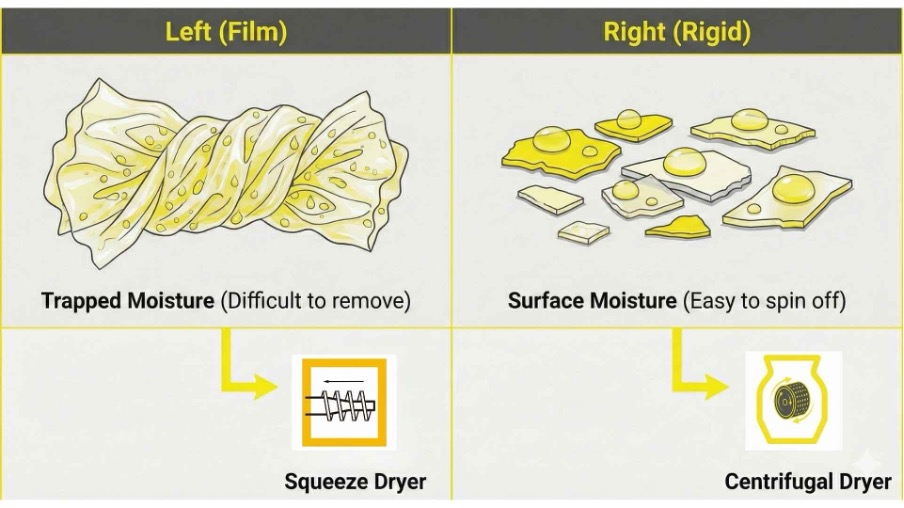
Flexible films tend to trap water within folds and wrinkles, making moisture removal a primary challenge during recycling. Rigid plastics, by contrast, retain their shape and carry moisture primarily on the surface. As a result, rigid materials respond more effectively to friction-based cleaning, density separation, and centrifugal drying. These fundamental differences explain why rigid plastic recycling requires a distinct process approach rather than a universal solution.
Attempting to process rigid plastics on film-oriented lines often leads to inefficiencies, contamination issues, and inconsistent output quality—making it critical when Choosing the Right Plastic Recycling Plant to match the system design to the material being processed.
This is because film-oriented lines are designed to address the specific challenges of flexible plastics rather than the surface contamination issues found in rigid waste.
| Feature | Flexible Film Line | Rigid Plastic Line |
|---|---|---|
| Material Behavior | Traps water in folds & wrinkles | Surface moisture only |
| Cleaning Focus | Mechanical Dewatering | Surface Friction Washing |
| Drying Technology | Squeeze Dryer | Centrifugal Dryer |
| Contamination | Internal moisture retention | Surface dirt, sand, organic residue |
| Ideal Waste | LDPE films, woven bags, agriculture films | HDPE bottles, PP crates, ABS bumpers |
Read more :
Rigid waste is often bulky and tough. Items like industrial drums, crates, and Automotive Bumpers (PP/ABS) cannot be fed into a standard granulator.
The solution is the Twin Shaft Shredder. Unlike single-shaft machines, Genius Machinery’s Kroko Twin Series utilizes high-torque, low-speed shafts to shear and tear apart massive, bulky, or mixed plastics. This design is critical for processing e-waste or automotive parts containing metal, as the robust blades are less susceptible to damage compared to high-speed granulators.
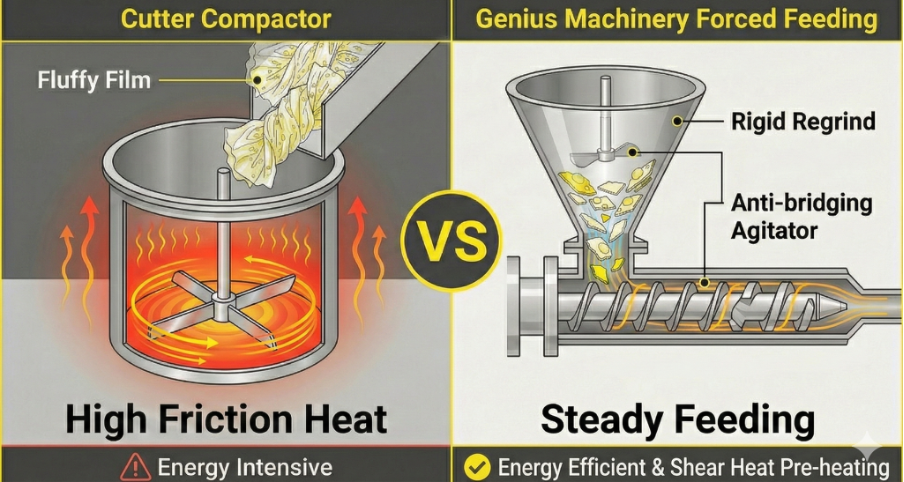
Once the rigid plastic is washed, dried, and shredded into flakes (regrind), feeding it into the extruder requires precision. While cutter-compactors are excellent for densifying light film, they generate friction heat that is often unnecessary for rigid flakes.
In real-world rigid recycling—especially with post-industrial or automotive materials—regrinds frequently carry strong chemical odors and volatile residues. Excess friction heat generated by cutter-compactors can intensify these odor-related issues rather than resolve them.
For this reason, advanced rigid recycling lines favor forced feeding combined with enhanced degassing design. By integrating double venting zones with high-efficiency vacuum pumps, these systems significantly improve odor removal, reduce volatile content, and deliver more stable melt quality and higher-grade recycled pellets.
For clean rigid regrinds such as HDPE bottles or PP caps, Forced Feeding is the technically superior choice.
In more demanding applications—such as painted automotive components—feeding and downstream filtration design become even more critical.
One of the most profitable segments in rigid plastic recycling today is the automotive industry. According to the EU ELV (End-of-Life Vehicle) Directive, automakers are under increasing pressure to increase recycled plastic content to meet circular economy goals.
However, recycling post-production PP/ABS bumpers presents a specific technical hurdle: paint residue. If not removed, paint creates defects that ruin the mechanical properties of the recycled resin.
Genius Machinery recently helped a European Tier-1 Supplier overcome this challenge. By implementing a customized Automotive Plastic Recycling Solution, the client achieved a closed-loop system.
While most surface paint can be reduced through pre-processing and mechanical cleaning, complete removal is rarely achievable in practice—making downstream melt filtration a critical requirement.
Setting up a rigid recycling plant is a significant capital commitment. To ensure a return on investment (ROI), buyers must match their equipment to their operational scale.
Read more : Choosing the Right Plastic Recycling Plant For My Business
Rigid plastics are among the most valuable materials in mechanical recycling due to their thickness, consistency, and ability to retain mechanical properties after reprocessing. When properly washed, filtered, and pelletized, recycled rigid plastics can replace virgin resins in demanding applications—reducing landfill waste, lowering carbon emissions, and improving resource efficiency across industries.
For sectors such as automotive, packaging, and industrial manufacturing, effective rigid plastic recycling is no longer just an operational decision but a strategic requirement driven by sustainability targets, regulatory pressure, and long-term material cost stability.
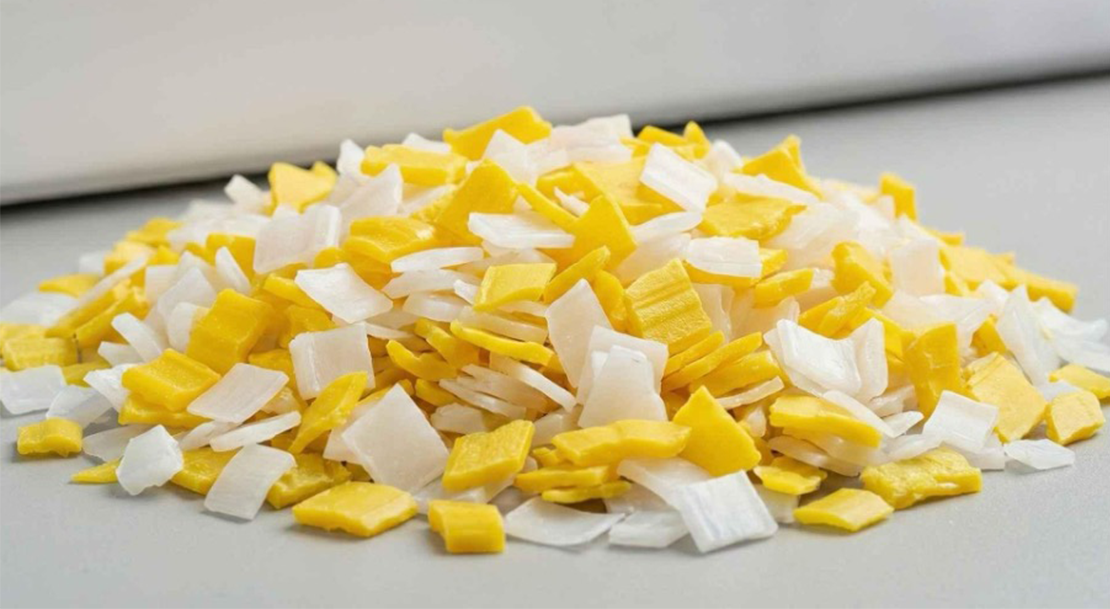
Rigid plastic recycling offers immense potential, but only if the equipment matches the material's physical properties and contamination levels. From utilizing Twin Shaft Shredders for heavy loads to selecting Self-Cleaning Filters for painted parts, every technical decision impacts your final pellet quality.
Whether you are complying with the EU ELV Directive or simply optimizing for energy efficiency, Genius Machinery offers turnkey solutions tailored to your specific needs.
Ready to upgrade your rigid recycling capabilities? Contact Genius Machinery today to discuss your material specifications, plant layout, and capacity requirements.


