
You've invested in sorting equipment. Your washing chemistry is dialed in. Your extruder is running clean. And yet — the pellets keep coming back rejected.
For recyclers producing PCR material destined for brand use, this is a familiar and costly frustration. A single rejected shipment doesn't just mean lost revenue. It means eroded trust with a buyer who had other options, a price premium that disappears the moment your consistency comes into question, and an internal postmortem that almost always points to the same culprit: moisture that wasn't removed at the dewatering stage.
Brands are tightening PCR content requirements. Raw material shortages are pushing more operations toward post-consumer waste streams. And the buyers setting specifications — packaging engineers and sustainability managers — are no longer willing to accept "close enough." In this environment, the equipment decision that most directly determines whether your post-consumer recycling output clears the quality bar isn't the extruder or the pelletizer. It's the dewatering stage — and it sits upstream of where most recyclers think to look.
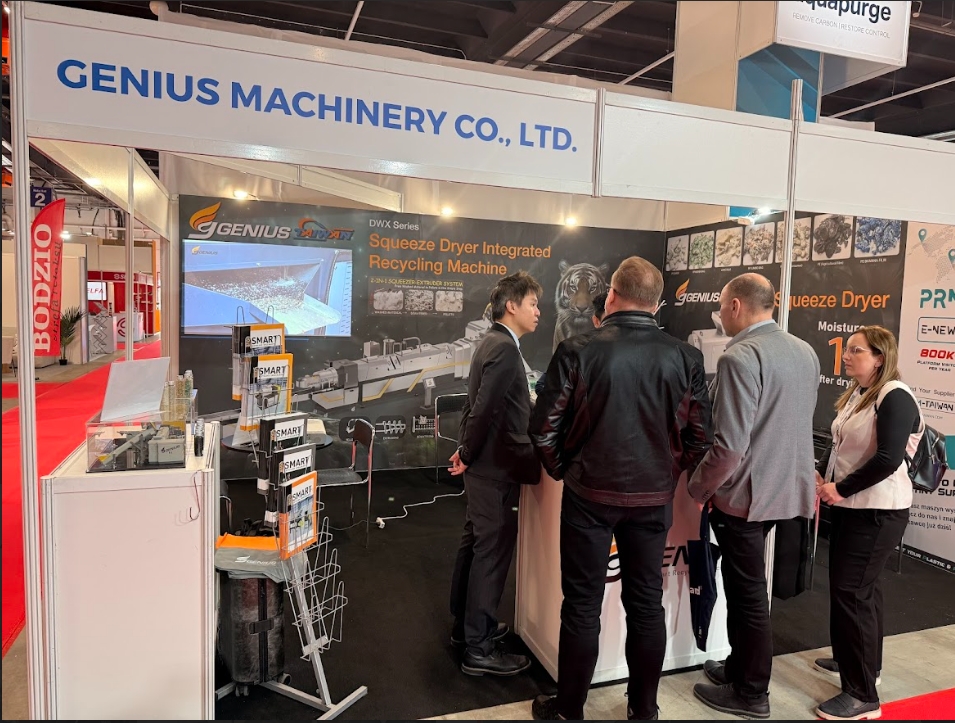
Genius Machinery at PLASPOL 2026 — the DWX Series Squeeze Dryer Integrated Recycling Machine drawing attention from recycling operators across Europe.
High-quality PCR resin requires a precise, interconnected system. While high-precision sorting and specialized chemical washing formulas are vital to overcoming upstream contamination, the dewatering stage acts as the final gatekeeper. The most direct downstream consequence of inadequate dewatering shows up at the melt filter — and it shows up in a way that is increasingly difficult to manage with labor.
High incoming moisture means the extruder barrel is processing steam alongside plastic melt. Steam spikes create pressure surges. Pressure surges accelerate screen loading. Reducing moisture before the melt stage is the most direct route to extending screen life, reducing change frequency, and lowering the labor burden at one of the most operationally sensitive points in the line.
This is the upstream problem that a screw press dewatering machine is designed to solve.
Read more: 6 Factors to Consider When Choosing Melt Filters for Plastic Recycling Extrusion Machines
Most discussions of squeeze dryer technology focus on energy savings and line footprint — and those benefits are real and well-documented in our squeeze-dry pelletizing line overview.
But for recyclers producing PCR material destined for brand use, the more important benefit is different: consistent dewatering is what separates recyclable waste from specification-grade PCR.
Brand buyers specifying PCR content in their packaging are not simply asking for pellets made from post-consumer material. They are asking for pellets that meet melt flow rate (MFR) specifications, color consistency specifications, and in some cases food-contact or FDA compliance requirements. These are the same standards that virgin resin has always met. Meeting them with post-consumer feedstock requires that every stage of the process be controlled with the same discipline.
Moisture is one of the most direct variables affecting PE/PP extrudate quality. Water entering the barrel creates vapor under process temperatures. That vapor produces bubble defects and creates surface irregularities in pellets that fail brand visual inspection.
Furthermore, post-consumer film streams are rarely perfectly uniform and frequently contain rigid fragments. Real-world operational experience shows that when a film reject stream contains around 10% rigid plastic regrind, a robust screw press handles the mix seamlessly. Even under extreme conditions where rigid fragments spike up to 30%, the equipment maintains operational resilience, continuing to output processable material with only minor, predictable trade-offs in throughput and moisture levels. A batch that leaves the wash line at 12% moisture and a batch that leaves at 2% moisture will not produce the same pellet — regardless of how good the extruder is.
For recyclers supplying into programs that require ISCC PLUS certification, APR certification, or brand-specific quality audits, output consistency is not optional. One rejected shipment erodes the price premium that made the post-consumer material strategy worthwhile in the first place.
Consistent dewatering — reliably achieving below 3% moisture entering the extruder, across variable input quality — is the operational foundation that everything else depends on. This is especially relevant as circular PE and other advanced applications set increasingly strict feedstock requirements, as covered in our article on whether your film recycling equipment is ready for circular PE.
Japan represents one of the most demanding benchmarks for PCR output quality globally — brand buyers there enforce zero-bubble-defect standards that leave no room for moisture inconsistency.
One facility processing post-consumer flexible packaging from municipal collection was running filter changes every 3 to 4 days. Moisture at the wash line outlet was routinely above 8%, with spikes during wet-season collection pushing past 12%. The unpredictability made planned maintenance impossible — and made it equally impossible to guarantee the pellet consistency that brand buyers required.
After integrating a mechanical squeeze dryer upstream of the extruder, outlet moisture stabilized consistently below 3% — the threshold required for stable extrusion in high-volume PCR film recycling applications. As a result, filter change intervals—which typically occurred every 1 to 3 days under higher moisture conditions—were extended by 1.5 to 2 times, successfully pushing the screen life to 2 to 6 days. Batch-to-batch pellet surface quality finally met the visual inspection threshold the brand buyer required, something that hadn't been achievable with thermal drying alone due to heat sensitivity in the film fraction.
Post-consumer waste makes different demands on dewatering equipment than agricultural film or production scrap does. Two criteria matter most when evaluating a machine for this application.
It is critical to note that a screw press squeeze dryer is engineered exclusively for mechanical dewatering at the post-wash stage, meaning it is designed to process materials that have already been thoroughly washed and cleaned. While it is not a filtration tool for removing heavy sand or stone debris, it must still possess extreme resilience against the microscopic, abrasive residuals typical of post-consumer waste (PCW). To withstand this demanding environment without premature failure, the quality of the screw is paramount. While conventional market alternatives often rely on welded screw flights that are prone to stress cracking, the Genius DW Series features a heavy-duty screw fully CNC-machined from a single, solid block of premium steel imported from Japan. This monolithic construction provides superior structural strength and torque resistance. Under standard operational guidelines and regular maintenance, this full-CNC screw delivers an exceptional lifespan of 2 to 3 years, ensuring long-term manufacturing stability and preventing costly unexpected downtime.
The relevant question is not whether the machine can achieve below 3% moisture on a clean test batch. It is whether it sustains that performance when feedstock quality fluctuates — which, with post-consumer material, it will. In the harsh environment of a washing plant, overly complex electronics can become a maintenance liability. Instead, look for a machine utilizing optimized screw geometry and heavy-duty mechanical components to lower the impact of density fluctuations. This allows operators to perform straightforward manual adjustments to the screw speed via an intuitive interface based on the incoming material batch, sustaining high-volume dehydration without constant high-tech micro-management.
For a detailed look at how squeeze dryers manage reject stream moisture in addition to primary-line dewatering — which becomes a meaningful secondary cost in high-volume PCW processing — the analysis in our article on cutting disposal costs and carbon footprint with squeeze dryer strategy covers this in depth.
The Genius DW Series Plastic Squeeze Dryer is engineered specifically for the contamination levels and moisture variability characteristic of post-consumer waste streams. Units are operating in post-consumer applications across Europe, Japan, Southeast Asia, and Africa — including in lines processing the kind of mixed-film PCW that presents the most demanding dewatering challenges.
Post-consumer recycled plastic is material that has been used by end consumers, collected through recycling programs, and reprocessed into new resin. Unlike post-industrial recycled material — which is clean manufacturing scrap that never reached end users — PCR comes from the general waste stream and carries a more variable contamination and moisture profile. This variability is what makes consistent processing more technically demanding, and why the equipment handling post-consumer material must be specified differently from equipment designed for cleaner industrial waste streams.
Brand buyers evaluating PCR resin don't test for moisture directly — they test for melt flow rate consistency, surface appearance, and the absence of bubble defects. These are the downstream symptoms of inadequate dewatering, and they show up as measurable failures at incoming quality inspection.
A batch arriving at 8% moisture and a batch arriving at 2% moisture will fail and pass the same visual and mechanical inspection for entirely predictable reasons. This is why moisture control at the dewatering stage is the most reliable lever recyclers have for consistently meeting buyer specifications — it addresses the root cause rather than trying to compensate downstream.
For most PCR pelletizing applications, the target is below 3% residual moisture at the squeeze dryer outlet — maintained consistently across varying input quality. This level is low enough to prevent steam-related extrusion defects while remaining achievable through mechanical dewatering, without the energy cost of thermal drying. The Genius DW Series Plastic Squeeze Dryer is designed to hold this threshold reliably even when incoming feedstock moisture fluctuates, which is the normal operating condition in post-consumer recycling lines.
Post-consumer plastic recycling is not a uniform process, and the right dewatering configuration depends on the specific waste stream you are processing — its contamination profile, incoming moisture range, and the output specifications you are trying to meet.
The most reliable way to determine whether your current setup is limiting your PCR output quality — or whether an upgraded dewatering stage would meaningfully reduce your filter maintenance burden — is to run the numbers against your actual material.
Contact Genius Machinery to discuss a material assessment, or review our field-proven case studies to see how recyclers with similar feedstock challenges have addressed them.
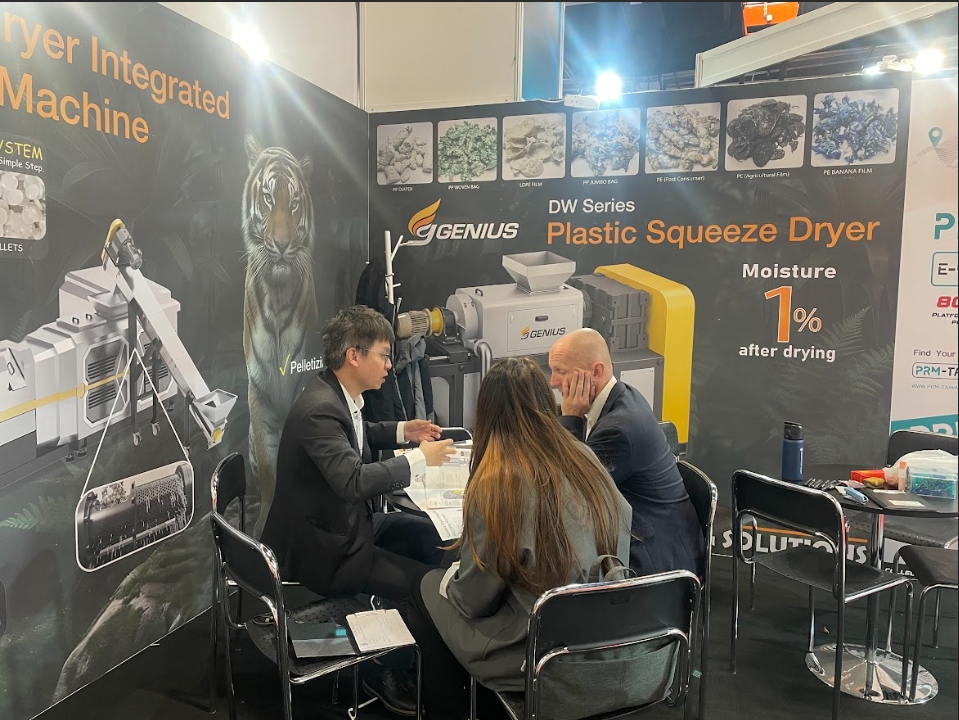
Genius at PLASPOL 2026 — discussing DW Series Plastic Squeeze Dryer specifications with recyclers processing post-consumer waste streams.


